Healing In Relationship: Expanding Our Capacity to Connect to Self, Body, Emotions, and Others
Welcome to Sitting With Lauren
Over the last few years, the way I understand healing has changed quite a bit.
Not because I suddenly discovered one new modality or framework that explained everything. If anything, it has been the opposite.
The deeper I've gone into trauma work, the nervous system, somatic experiencing, parts work, attachment, movement, and my own experience of being human, the more I've found myself coming back to something surprisingly simple:
Healing happens in relationship.
In our relationships with other people, yes. But also in the relationships we develop with our bodies, our emotions, our protective patterns, and eventually, ourselves.
And I think this is part of why Sitting With Lauren feels like the right name for this next chapter of my work.
Because I'm becoming less interested in asking, How do we get rid of this?
And much more interested in asking:
Can we sit with this for a moment?
Can we get curious about what's happening?
Can we understand why this response might make sense before we try to change it?
And perhaps most importantly:
What becomes possible when we experience a different way of relating to ourselves?
These are some of the ideas that have been shaping my work lately.
You aren't broken. You adapted.
So many of the things we struggle with can feel like evidence that something is wrong with us.
The anxiety.
The overthinking.
The part that procrastinates even though you desperately want to move forward.
The part that shuts down during conflict.
The part that wants connection and then suddenly wants everyone to leave you alone.
The perfectionism. The people-pleasing. The numbness. The constant scanning.
It's very easy to look at those patterns and think:
Why am I like this?
But I wonder what happens when we change the question.
Instead of:
What's wrong with me?
What if we ask:
What happened that taught my system this response was necessary?
Or:
What might this part of me be trying to protect?
Because our responses don't develop in a vacuum.
Our nervous systems learn.
They adapt.
They organize around what has helped us find safety, maintain connection, avoid pain, or get through experiences that once felt too much.
That doesn't mean every strategy that once protected us is still helping us today.
Sometimes the very strategies that helped us survive are the ones creating pain now.
But understanding why they're here gives us somewhere very different to begin.
Not correction.
Curiosity.
Healing happens at the pace of the nervous system.
This is something I come back to again and again in my work:
We cannot rush a nervous system into feeling safe enough for something it isn't ready for.
And yet so much of healing can carry an incredible sense of urgency.
I understand this. Why am I still doing it?
I've been in therapy for years. Why does this still affect me?
I know I'm safe now. Why doesn't my body know that?
The mind may understand something long before the body has had enough experiences to believe it.
And that distinction matters.
Sometimes healing asks us to slow down enough to notice what happens when we don't immediately push past an experience.
What happens in your breath?
Your shoulders?
Your stomach?
Do you want to move toward something?
Away from it?
Do you want to curl inward, reach outward, turn your head, move, stretch, walk, rest?
The body is communicating all the time—not only through symptoms, but through sensation, posture, movement, impulse, breath, rhythm, and attention.
Learning to listen doesn't mean obeying every sensation or forcing ourselves to stay with something overwhelming.
Sometimes listening means recognizing:
That's enough for today.
That is part of healing too.
Capacity creates the space for healing to unfold.
This idea has become incredibly important to me.
We often measure healing by asking whether something has disappeared.
Am I less anxious?
Do I dissociate less?
Am I less triggered?
Do I feel better?
And of course, symptom relief matters.
But I've become increasingly interested in another question:
What am I becoming more able to be with?
Can I notice anxiety without immediately needing to escape it?
Can I experience sadness and still remain connected to myself?
Can I feel joy without immediately bracing for something bad to happen?
Can I notice that one part of me desperately wants connection while another part wants to run—and make room for both?
That is capacity.
Not the ability to tolerate endless discomfort.
Not forcing ourselves to stay present.
Not becoming unaffected by life.
Capacity is the space that slowly develops around our experiences.
And I think of it as a bridge.
We can understand something intellectually on one side of that bridge.
But understanding alone doesn't always change what happens inside of us.
We need experiences.
Small, tolerable, repeated experiences of something being different.
And as our capacity expands, those experiences have somewhere to land.
They can begin to integrate.
Understand → Experience → Integrate.
Capacity helps us cross the bridge between them.
Regulation isn't the goal.
This one might sound strange coming from someone who talks about the nervous system as much as I do.
But I don't think the goal of healing is to become regulated all the time.
Human nervous systems aren't supposed to be calm all the time.
We mobilize.
We shut down.
We get excited.
We become scared.
We grieve.
We connect.
We pull away.
We come back.
The question isn't whether we can prevent ourselves from ever becoming dysregulated.
I'm much more interested in the relationship we have with ourselves when we do.
Can I notice what's happening without immediately deciding something is wrong with me?
Can I stay curious?
Can I offer myself support?
Can I recognize when I need someone else?
Can I find my way back?
Over time, regulation can begin to emerge more naturally from that relationship.
So can resilience.
So can self-trust.
Not because we've mastered our nervous systems.
But because we've had repeated experiences of discovering:
I can stay with myself here.
And sometimes, we learn that through someone else first.
I think this piece is incredibly important.
We talk a lot about self-regulation, self-trust, self-compassion, self-attunement.
But for many of us, these capacities weren't developed alone.
We understand ourselves, in part, through first being understood.
Sometimes we learn curiosity because someone was curious about us when we expected criticism.
We learn that an emotion can be survived because someone stayed with us while we felt it.
We learn that we don't have to rush because someone else didn't rush us.
We learn that conflict doesn't always mean abandonment because someone remained connected.
We learn to listen to our bodies because someone helped us notice what they were already communicating.
And slowly, those experiences can become internalized.
The way someone once sat with us can begin to become the way we sit with ourselves.
This is what I mean when I say:
Healing happens through relationship.
Healing isn't about becoming someone new.
I think healing is sometimes sold to us as transformation into a different person.
A calmer person.
A more confident person.
A more secure person.
A version of ourselves who finally doesn't struggle with all the things we've spent years trying to overcome.
I'm less interested in that version of healing.
I don't think we need to leave the protective parts of ourselves behind.
I think we can develop a different relationship with them.
We can become curious about the anxious part.
Listen to the body that wants to pull away.
Understand the critic before immediately trying to silence it.
Notice the part that feels ashamed without agreeing with everything shame tells us.
And from that relationship, something can begin to shift.
Maybe healing isn't about becoming a new version of ourselves.
Maybe it's about having enough space, support, and capacity to meet more of who we already are.
So, what does Sitting With Lauren actually mean?
I've been thinking about this question a lot.
What does it mean to sit with something?
To me, it isn't passive.
And it certainly doesn't mean staying stuck.
It's the moment where we resist the urge to immediately fix, explain, suppress, override, or move past an experience.
It's the moment where we become curious.
What's happening here?
What am I noticing in my body?
What is this emotion communicating?
What might this part be protecting?
What do I need right now?
And sometimes there isn't much of a pause.
Sometimes our nervous systems respond before we even realize what's happening.
Sometimes sitting with ourselves feels uncomfortable, unfamiliar, or even impossible.
That's information too.
Because for many of us, learning to sit with ourselves begins by experiencing what it feels like for someone else to sit with us.
Someone stays.
Someone doesn't rush.
Someone is curious when we expected judgment.
Someone helps us notice our body without demanding that it change.
Someone remains connected when we expected them to leave.
And slowly, perhaps, we begin to offer some of that same relationship to ourselves.
That's also why the pause in the Sitting With Lauren logo means so much to me.
It represents that little bit of space between experience and response.
Not a demand to calm down.
Not a demand to regulate.
Not even a demand to change.
Just an invitation to notice.
To wonder.
To listen.
To understand.
And perhaps, over time, to experience something different.
That's what I hope Sitting With Lauren can be.
Not another place telling you how to fix yourself.
A place where we can become curious, together, about what happens when we learn to relate to ourselves differently.
With hope,
Lauren
Stay connected with news and updates!
Recent Posts
Author
Lauren
Author
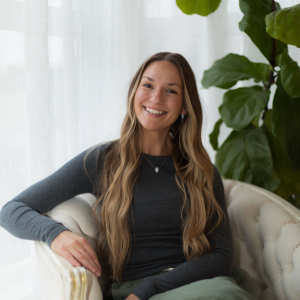
Hi! I’m Lauren Rasmussen (she/her), a Somatic Trauma Psychotherapist and Registered Psychotherapist (Qualifying). I support individuals navigating complex and relational trauma, nervous system dysregulation, emotional overwhelm, and disconnection from self or body.
